

Mona Lisa: The People and the Painting
By Martin Kemp and Giuseppe Pallanti
Oxford University Press (2017)
Mona Lisa originated as a portrait of a particular Florentine woman and evolved into a philosophical meditation. This is author Martin Kemp’s intriguing contention in a book that explores multiple topics related to the world’s most famous painting.
An eminent da Vinci scholar, Kemp relates the portrait's contents to Leonardo’s diverse activities and studies during the several years he worked on the undelivered painting. His military and civil engineering work on rivers and canals provided crucial data for his revolutionary insights about the ancient age of Earth, while his human dissections culminated in a monumental composite drawing of the female anatomy. Guided by the age-old microcosm-macrocosm analogy—viewing man as a miniature version of the world—Leonardo painted stark mountains and tiered lakes to reflect Earth’s vast geological transformations over eons. Kemp concludes that both the anatomical study and Mona Lisa are explorations of "the woman's microcosmic presence in nature" (p. 187).
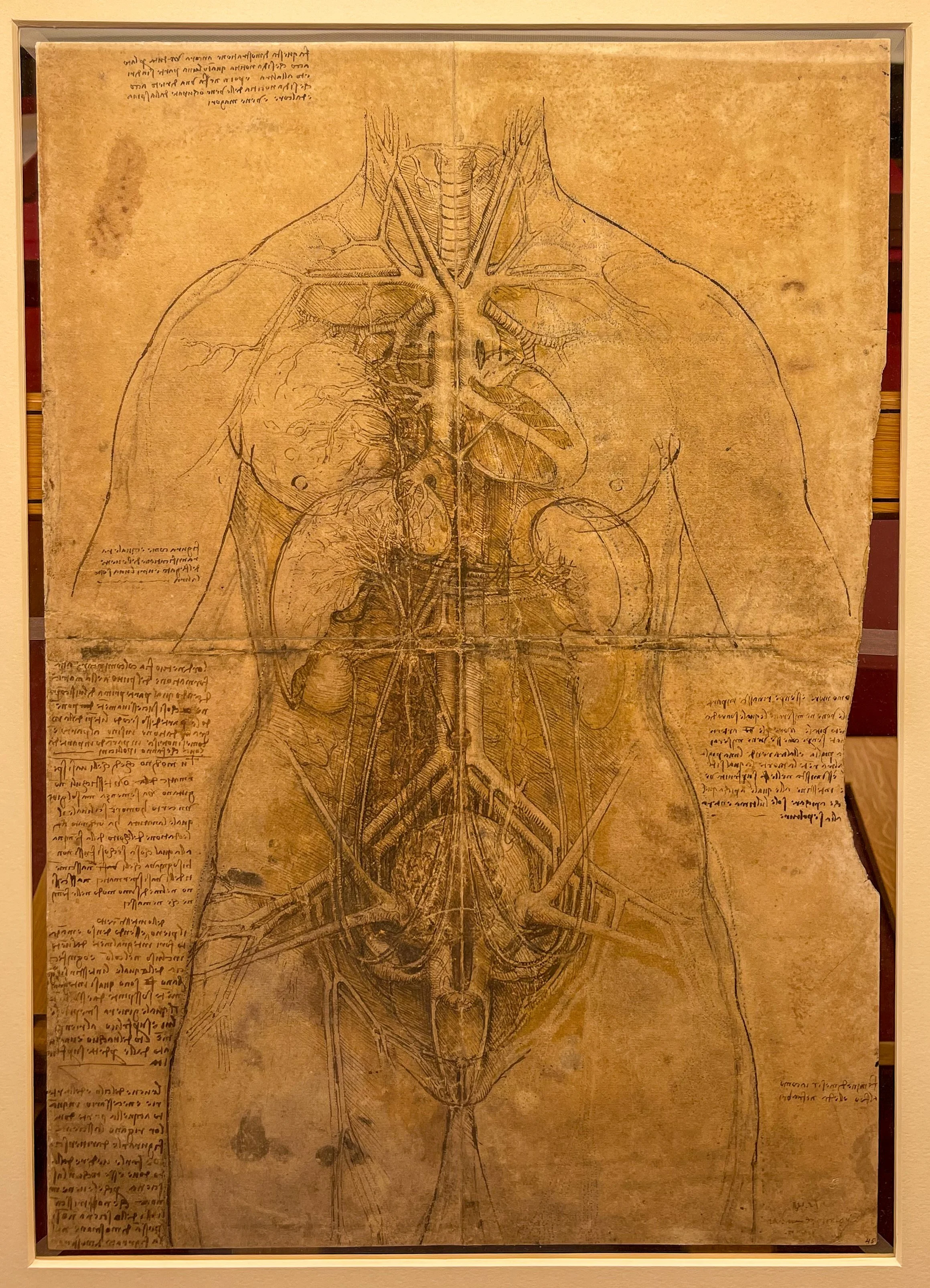
Leonardo da Vinci’s composite drawing of the female organs and irrigation and cardiovascular systems is housed at Windsor Castle in London. (Photo: Joseph Kellard)
Further, Leonardo's optical studies suffuse the painting, in the fading details of distant mountains, the absence of any clear outlines, and the subtle gradations of shadow intensity, demonstrating his understanding of how light behaves. His grasp of physics animates Mona Lisa's hair and the cloth of her costume, which Kemp argues is less realistic period dress than artistic abstraction and fantasy.
In her most notable physical features, Mona Lisa also reflects Renaissance love poetry celebrating the “sweet smiles” and “loving eyes” of beloved or idealized but unattainable women. Leonardo favored Dante, partly because his poetry integrated science—particularly optics—with imagination. Through his analysis of poetic passages, Kemp concludes that Mona Lisa represents "at once a real person and a poetic enigma" (p. 168)
“Aligning Leonardo’s studies—mathematics, optics, anatomy, geology, statics, dynamics, and the broader philosophy of nature and life—with the visual qualities of the Mona Lisa, it is difficult to know where to stop.
”
In short, Mona Lisa is Leonardo’s ultimate amalgam of science, poetry and art–a “universal picture.”
Overall, the book examines wide-ranging topics both intimately and remotely related to the painting. Drawing on the painstaking archival research of his co-author Giuseppe Pallanti, Kemp writes in great detail about the lives and families of Lisa Gherardini, her wealthy silk merchant husband Francesco del Giocondo, and the renowned Renaissance master. Particularly interesting is the authors' detective work on Leonardo's mysterious mother. They track information allowing them to confidently lay to rest her long-debated identity by naming her as Caterina di Meo Lippi, an orphaned teenager who lived with relatives in Leonardo’s birthplace, the village of Vinci.

Crowds swarming the Mona Lisa are a common sight at the Louvre in Paris. (Photo: Joseph Kellard)
Kemp's narrative also details the painting's compelling history—its various copies, restorations and changing owners—as well as its theft from the Louvre in 1911 that catapulted the work to international fame. The book also examines modern interpretations of Mona Lisa's mystique that cast her as everything from ancient soul to femme fatale. Kemp even delves into the technicalities of modern imaging, revealing hidden details beneath the painting’s surface and Leonardo's artistic process and changes.
The People and the Painting provides a comprehensive portrait of the web of Florentine individuals, relationships, and circumstances that contributed to the painting's creation and its transformation into an international icon and phenomenon.