

The Indian Hunter was such a seminal work in the career of sculptor John Quincy Adams Ward (1830–1910) that after his death, his wife commissioned a copy of the statue to guard his grave in his native Urbana, Ohio.
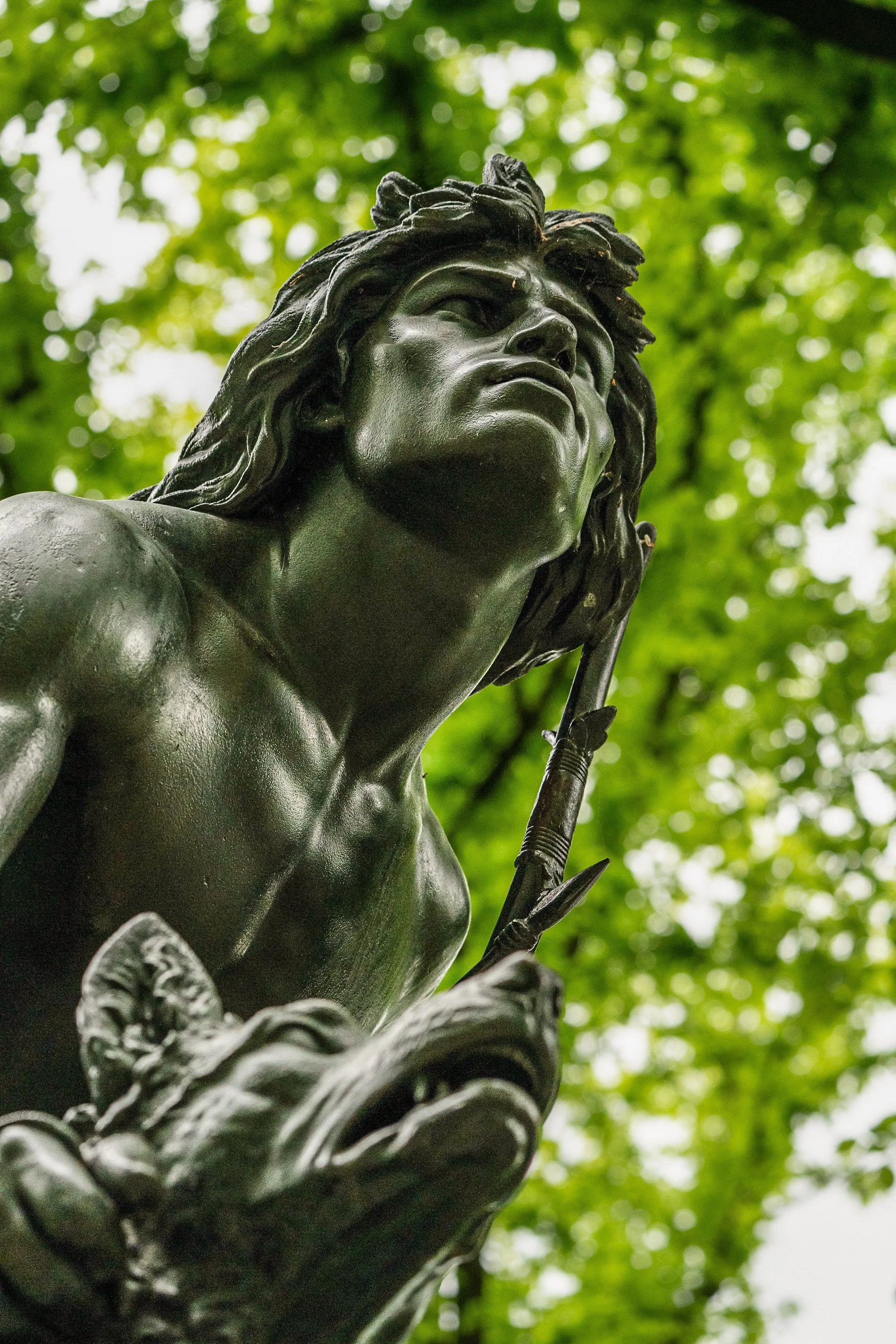
Today, the most celebrated of various Indian Hunter versions stands on a pedestal under a canopy of shade trees in Central Park in New York City. This spot, near the southwest end of the Mall — sandwiched between the heavily trafficked Literary Walk and the wide-open Sheep Meadow — suggests an appropriately forest-like setting for this bronze statue of an American Indian on the prowl with his snarling dog that appears to have spotted potential prey.

Ward, who would earn the moniker "dean of American sculptors," had traveled to the Dakotas to sketch American Indians as potential models for his statue, which he developed across several versions. The most significant early iteration was a small statuette he exhibited at the National Academy of Design in 1862. After the Civil War, Ward enlarged this model into a full-sized sculpture and caught the admiring eyes of August Belmont, a member of the Board of Commissioners of Central Park.

Consequently, in 1866, New York's L.A. Amouroux foundry cast the statue in bronze for display in Central Park, thanks to a group of 23 prominent citizens who covered the $10,000 casting cost. They were "driven by a romantic appreciation of Native American life and respect for Ward's noble interpretation," according to the NYC Parks website. The statue was exhibited at the 1867 Paris Exposition and dedicated in the park in February 1869. It represents the first sculpture by an American artist to be placed there. Other full-scale casts of the Indian Hunter were made for Cooperstown and Buffalo, as well as Ward’s grave marker in Urbana.


The Indian Hunter catapulted Ward's career, garnering him ever more commissions. In addition to this sculpture, Ward had three others dedicated in Central Park: William Shakespeare (1872), Seventh Regiment Memorial (1874), and The Pilgrim (1885).
Ward's most famous work is his statue of George Washington (1883) at the front of Federal Hall National Memorial on Wall Street, the site of the first president's inauguration (but not the original building). Among his other sculptures are the Major General John F. Reynolds Statue (1872) at Gettysburg National Cemetery and the James A. Garfield Monument (1887) in Washington D.C., on the grounds of the United States Capitol.
